
Where is the VIN? Every place to look
The 17-character vehicle identification number (VIN) is on the vehicle in at least two places and on every important document. Here is where to find it on a car, a pickup, a motorcycle and a trailer, and on the papers.
Where to find your VIN
The vehicle identification number (VIN) has 17 characters and appears in several places. They must all match: a difference is a red flag.
- Dashboard, driver side
Look through the windshield in the lower left corner, where the dash meets the glass.
- Driver-side door jamb
The sticker or plate on the B-pillar or door edge (Federal Motor Vehicle Safety Standard label).
- Engine bay or frame
Stamped on the firewall or, on trucks, on the frame rail near the front wheel.
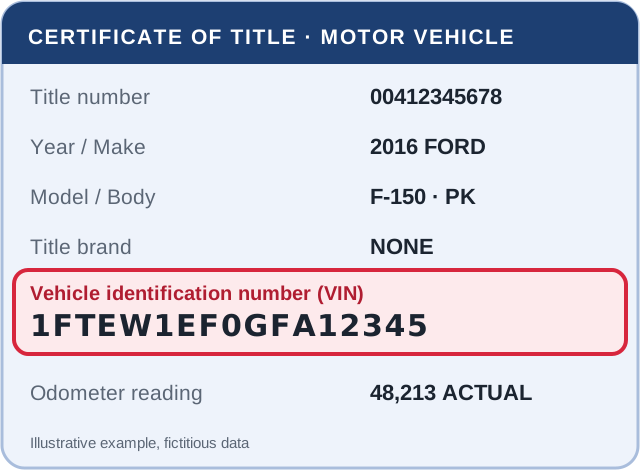
- Title certificate
Every state title shows the VIN near the year, make and model.
- Registration card
The registration card in the glove box repeats the VIN.
- Compare with the car
If the VIN on the title differs from the one on the dashboard, do not buy until it is explained.
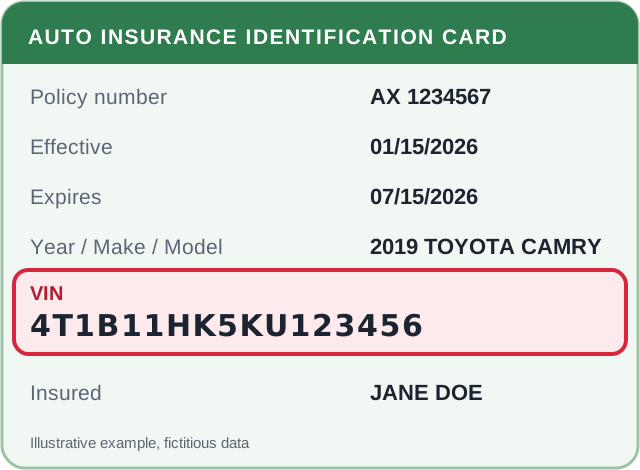
- Insurance ID card
Your insurance card or app lists the VIN of each covered vehicle.
- Policy documents
The declarations page of the policy shows the full VIN too.
- Service records
Repair orders and dealer invoices usually carry the VIN as well.
Where the VIN is on each type of vehicle
Car, SUV or minivan
- Dashboard. In the lower left corner of the windshield, readable from outside. US cars have had it there since 1969.
- Driver-side door jamb. On the safety certification label (the sticker with the build date, GVWR and tire pressures) on the door edge or the B-pillar.
- Engine bay. Stamped on the firewall or on a plate under the hood on many models.
- Other spots. Some makers repeat it under the carpet on the passenger side, in the trunk under the spare wheel or on major body panels.
Pickup truck
- Dashboard and door jamb. The same places as on a car.
- Frame. Stamped on the frame rail, usually on the driver side near the front wheel or behind it. Look here when the dashboard plate is damaged.
- GVWR on the label. The door label also shows the gross vehicle weight rating, which the VIN of a truck encodes too.
Motorcycle
- Steering neck. Stamped on the frame at the steering head, the tube that holds the front forks; turn the handlebars to read it.
- Frame near the engine. Some makers stamp it on the frame down tube or near the engine mounts; a label is often on the frame as well.
- Engine number. The engine has its own number on the crankcase. It is not the VIN, but it must match the papers too.
Trailer or RV
- Tongue or A-frame. On the drawbar, stamped or on a plate, near the hitch.
- Front of the frame. On the left (driver-side) front of the frame or on the certification label there.
- RV. On a motorhome, the VIN is on the dashboard and door jamb of the chassis; the camper part has its own data plate inside.
Documents that show the VIN
- Certificate of title
Every state title shows the VIN next to the year, make and model. The VIN on the title must match the car before you pay.
- Registration card
The card you keep in the glove box repeats the VIN; so does the renewal notice from the DMV.
- Insurance ID card
Your insurer prints the VIN of each covered vehicle on the ID card and in its app.
- Loan and sale papers
The bill of sale, the loan contract and the lease agreement name the vehicle by its VIN.
- Service records
Dealer and repair shop invoices usually carry the VIN; so do recall letters from the maker.
- Police and insurance reports
Accident reports and claims identify the vehicle by VIN, which is how a history report finds them.
Compare the VIN in at least three places: the dashboard, the door jamb label and the title. A scratched, re-riveted or loose VIN plate, or a title VIN that differs by one character, is a classic sign of a stolen or cloned car.
Decode the VIN for free
Type the 17 characters: make, model, year, engine and plant, then the history if you need it.
Finding the VIN
Can I find the VIN without the car?
Yes: on the title, the registration card, the insurance card or the insurer's app, and on most service invoices. If you have none of them, the DMV or your insurer can tell you the VIN of a vehicle registered or insured in your name.
Can I look up a VIN by license plate?
Some paid services can, but the DMV does not give owner or VIN data to the public: the Driver's Privacy Protection Act limits access to registration records. When you buy a car, ask the seller for the VIN; an honest seller will share it.
The VINs on the dashboard and the door are different. Why?
They must be identical. A difference can mean a replaced door after an accident (then the door label may be missing, not different) or a VIN that was tampered with. Do not buy until it is explained, and check the history.
Is the chassis number the same as the VIN?
On modern vehicles, yes: the chassis or frame number is the 17-character VIN. Older and Japanese-market vehicles may have a shorter frame number instead.
More VIN guides
VIN year chart
The model year from the 10th character, 1980 to 2039, and how to tell 1990 from 2020.
VIN check digit calculator
Check the 9th character of any VIN: a wrong check digit means a typo or a fake VIN.
Free VIN check
Recalls, theft and title records from NHTSA, NICB and NMVTIS: what is free and what is not.
Salvage title check
Salvage, rebuilt, flood and junk titles: what they mean and how to find them by VIN.