
Free VIN decoder and lookup
Enter the 17-character vehicle identification number (VIN) and see the make, model, model year, engine and plant for free. US-market vehicles are decoded with the official NHTSA data.
- Free
- No sign-up
- Instant result
Where to find the VIN on a car, truck or title
On a car or light truck the VIN is visible through the windshield at the lower left of the dashboard and on the driver-side door jamb. On paperwork, look at the certificate of title, the registration card and the insurance ID card. All copies must match exactly.
- Dashboard, driver side
Look through the windshield in the lower left corner, where the dash meets the glass.
- Driver-side door jamb
The sticker or plate on the B-pillar or door edge (Federal Motor Vehicle Safety Standard label).
- Engine bay or frame
Stamped on the firewall or, on trucks, on the frame rail near the front wheel.
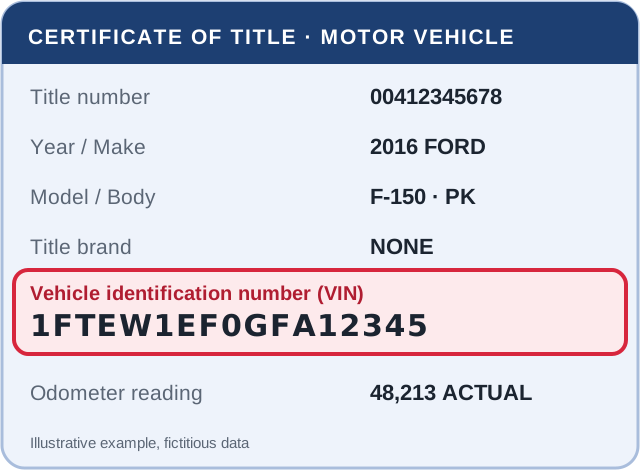
- Title certificate
Every state title shows the VIN near the year, make and model.
- Registration card
The registration card in the glove box repeats the VIN.
- Compare with the car
If the VIN on the title differs from the one on the dashboard, do not buy until it is explained.
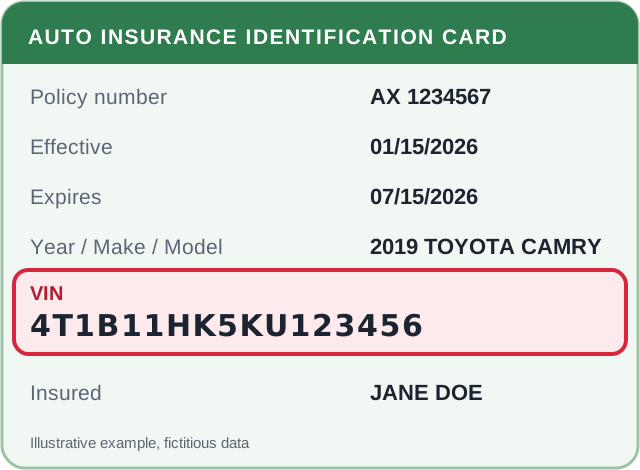
- Insurance ID card
Your insurance card or app lists the VIN of each covered vehicle.
- Policy documents
The declarations page of the policy shows the full VIN too.
- Service records
Repair orders and dealer invoices usually carry the VIN as well.
What is a VIN?
The vehicle identification number (VIN) is a unique code given to every car, truck, motorcycle and trailer at the factory. Since the 1981 model year it has 17 characters, without spaces and without the letters I, O and Q, which could be read as 1 and 0. Each section says something about the vehicle: where and by whom it was built, the model and engine, the model year, the plant and its serial number.
How to decode a VIN number
Tap or hover over a part of the example VIN to see what it means. The three sections: WMI (1–3), VDS (4–9) and VIS (10–17).
The first character is the region or country (1, 4, 5 = USA); the first three together identify the maker (1HG = Honda, USA; 1FT = Ford trucks; JTD = Toyota, Japan).
Each maker codes the model line, body style, engine and restraint system here (CM826 = Accord EX-V6 coupe, 3.0 L V6).
Computed from the other 16 characters; mandatory in the US and Canada. A wrong check digit means a typo or a fake VIN.
The model-year code: 3 = 2003 (see the table below). The model year can start in the previous calendar year.
The factory that built the vehicle (A = Marysville, Ohio, for this Honda).
The unique serial number of the vehicle on that line.
How to use the VIN decoder
- 1Copy the VIN
From the dashboard, the driver-side door jamb, the title, the registration or the insurance card.
- 2Enter the 17 characters
In the field above, then press “Decode free”.
- 3See what the vehicle is
Make, model, trim, engine, model year, plant and safety equipment for US-market VINs (NHTSA data); the likely model and specs from our catalog for European VINs.
- 4Open the history
For accidents, title brands, odometer readings and past listings: the full carVertical report.
The decoder is built for vehicles made from 1981 onward; older vehicles can have shorter VINs. US, Canadian and Mexican VINs are decoded with the free NHTSA vPIC service (the official US source). For European VINs the model and engine are estimated from VINs with the same pattern decoded before.
How the check digit works
Each letter gets a value (A=1, B=2 … J=1, K=2 … S=2 … Z=9), each position a weight (8, 7, 6, 5, 4, 3, 2, 10, 0, 9, 8, 7, 6, 5, 4, 3, 2). Multiply, add up and divide by 11: the remainder is the 9th character (10 is written as X). A VIN that fails this test has a typo, or was altered.
Engine code from the VIN
For US-market vehicles the 8th character usually encodes the engine, and the NHTSA data names it (displacement, cylinders, fuel). The engine number itself is stamped on the block; our catalog lists the engine codes for each version.
Free decode vs. history report
The free decode tells you what the vehicle is: make, model, year, engine, plant and equipment. It does not tell you what happened to it. Accidents, salvage or flood titles, odometer readings and past listings are in a paid history report; theft and total-loss records are free at NICB VINCheck.
Model year codes (10th character)The same code repeats every 30 years (“A” = 1980 or 2010); the 7th character tells them apart on US vehicles (a digit before 2010, a letter from 2010).
| Code | Year | or | Code | Year | or | Code | Year | or |
|---|---|---|---|---|---|---|---|---|
| A | 1980 | 2010 | L | 1990 | 2020 | Y | 2000 | – |
| B | 1981 | 2011 | M | 1991 | 2021 | 1 | 2001 | – |
| C | 1982 | 2012 | N | 1992 | 2022 | 2 | 2002 | – |
| D | 1983 | 2013 | P | 1993 | 2023 | 3 | 2003 | – |
| E | 1984 | 2014 | R | 1994 | 2024 | 4 | 2004 | – |
| F | 1985 | 2015 | S | 1995 | 2025 | 5 | 2005 | – |
| G | 1986 | 2016 | T | 1996 | 2026 | 6 | 2006 | – |
| H | 1987 | 2017 | V | 1997 | 2027 | 7 | 2007 | – |
| J | 1988 | 2018 | W | 1998 | – | 8 | 2008 | – |
| K | 1989 | 2019 | X | 1999 | – | 9 | 2009 | – |
World manufacturer identifier (WMI): country codesThe first three characters identify the maker; the first one is the region, and the first two usually the country.
| First character | Region | Countries |
|---|---|---|
| A–H | Africa | AA–AH South Africa |
| J–R | Asia | J Japan · KL–KR South Korea · L China · MA–ME India · MF–MK Indonesia · ML–MR Thailand · PL–PR Malaysia · RF–RG Taiwan |
| S–Z | Europe | SA–SM United Kingdom · SN–ST and W Germany · SU–SZ Poland · TA–TH Switzerland · TJ–TP Czech Republic · TR–TV Hungary · TW Portugal · UU–U7 Romania · VA–VE Austria · VF–VR France · VS–VW Spain · XL–XM Netherlands · X3–X0 Russia · YA–YE Belgium · YF–YK Finland · YS–YW Sweden · ZA–ZR Italy |
| 1–5 | North America | 1, 4, 5 United States · 2 Canada · 3 Mexico |
| 6–7 | Oceania | 6A–6W Australia · 7A–7E New Zealand |
| 8–9 | South America | 8A–8E Argentina · 8F–8J Chile · 9A–9E and 93–99 Brazil · 9F–9J Colombia |
VIN decoding in short
Is the VIN decoder really free?
Yes. Decoding the VIN (make, model, model year, engine, plant and, for US vehicles, trim and safety equipment) is free and needs no sign-up. The vehicle history – accidents, title brands, odometer readings – is a paid carVertical report; theft and total-loss records are free at NICB VINCheck.
What does each digit in a VIN mean?
Characters 1–3 are the manufacturer (WMI), 4–8 describe the model, body and engine, 9 is the check digit, 10 the model year, 11 the assembly plant and 12–17 the serial number.
How do I find the model year from a VIN?
Read the 10th character and look it up in the year table above: for example K = 2019, L = 2020, R = 2024, S = 2025. Letters repeat every 30 years; on US vehicles a letter in position 7 means 2010 or later.
Can a VIN tell me if a car was in an accident?
Not by itself. The VIN is the key to the records: a history report searches insurance, salvage, title and police databases by VIN and shows accidents, salvage or flood titles and odometer readings.
How many characters does a VIN have?
17 for vehicles built from 1981 on, without the letters I, O and Q. Older vehicles can have shorter numbers that the decoder cannot read.
VIN decoder by brand
WMI codes, North American plants, examples and models of each brand.
 Alfa Romeo
 Alpina
 Aston Martin
 Audi
 Bentley
 BMW
 Bugatti
 Cadillac
 Chevrolet
 Chrysler
 Citroën
 CUPRA
 Dacia
 Daewoo
 Daihatsu
 Dodge
 DS
 Ferrari
 Fiat
 Ford
 GMC
 Great Wall
 Honda
 Hummer
 Hyundai
 Infiniti
 Jaguar
 Jeep
 Kia
 Koenigsegg
 Lada
 Lamborghini
 Lancia
 Land Rover
 Lexus
 Lotus
 Maserati
 Mazda
 Mercedes-Benz
 MG
 MINI
 Mitsubishi
 Moskvich
 NIO
 Nissan
 Opel
 Pagani
 Peugeot
 Porsche
 RAM
 Renault
 Rolls-Royce
 Rover
 Saab
 SEAT
 Škoda
 smart
 Subaru
 Suzuki
 Tesla
 Toyota
 Vauxhall
 Volkswagen
 Volvo
VIN decoder by country (28 countries)
VIN tools and guides
Where is the VIN?
Car, truck, motorcycle, trailer and the papers: every place the 17 characters are printed.
VIN year chart
The model year from the 10th character, 1980 to 2039, and how to tell 1990 from 2020.
VIN check digit calculator
Check the 9th character of any VIN: a wrong check digit means a typo or a fake VIN.
Free VIN check
Recalls, theft and title records from NHTSA, NICB and NMVTIS: what is free and what is not.
Salvage title check
Salvage, rebuilt, flood and junk titles: what they mean and how to find them by VIN.
Decoded VIN examples
Real VINs decoded on DecodeThatVIN, with the make, model and year read from the code.
WAUZZZ8T5DA065181AUDI A5 (8T3)WBA1J7109FV225633BMW 2 Coupe (F22, F87)WBANX710X0CS63391BMW 5 (E60)WBACV610X0LJ66375BMW X5 (G05, F95)VF7KFRHCMGS502382CITROËN DS5VF7YC3MFC12D62053CITROËN JUMPER VanJDAM300S001029814DAIHATSU SIRION (M3_)JDAJ210G001060781DAIHATSU TERIOS (J2_)3E4PK5FY0BT545646FIAT FREEMONT (345_)WF0FXXWPCFHG69458FORD FOCUS Saloon (DFW)SHSRE5880DU020322HONDA CR-V III (RE_)ZLA831AB000552334LANCIA DELTA I (831_)SALEA7BNXL2012176LAND ROVER DEFENDER Station Wagon (L663)SALYA2BN7LA243249LAND ROVER RANGE ROVER VELAR (L560)JMZGJ691651171416MAZDA 6 Estate (GJ, GL)JMZGHA4B601468308MAZDA 6 Hatchback (GH)JMZKEN91800273179MAZDA CX-5 (KE, GH)WDD2120571A457812MERCEDES-BENZ E-CLASS (W212)WDC1641221A234465MERCEDES-BENZ M-CLASS (W164)WDF44781513123253MERCEDES-BENZ MARCO POLO Camper (W447)SJNFEAJ11U2245374NISSAN QASHQAI II SUV (J11, J11_)W0L000054R2705004OPEL ASTRA F Hatchback (T92)W0VBE8EK2H8103408OPEL ASTRA K Sports Tourer (B16)W0L0XCF6864042229OPEL CORSA C (X01)W0LJC7EE0DB175799OPEL MOKKA / MOKKA X (J13)W0LJD7EM0H4110658OPEL MOKKA / MOKKA X (J13)VF33CNFUC82118042PEUGEOT 307 (3A/C)VF3MCYHZULL100057PEUGEOT 5008 II (MC_, MJ_, MR_, M4_)WP0ZZZ99ZFS172820PORSCHE 911 (991)VF1BB0WCF27090114RENAULT CLIO II (BB_, CB_)VF1VB000057322313RENAULT MASTER III Platform/Chassis (EV, HV, UV)VF1KZ140650267045RENAULT MEGANE III Grandtour (KZ0/1)VF1RFB00858671134RENAULT MEGANE IV Grandtour (K9A/M/N_)VF610A364KD017110RENAULT TRUCKS TTMBAH7NP6K7016788SKODA SUPERB III (3V3)WV1ZZZSYZJ9044685VW CRAFTER Van (SY_, SX_)WVWZZZ1JZ2B020071VW GOLF IV (1J1)WVWZZZ1KZ7W061599VW GOLF VI (5K1)