
VIN Decoder Explained
VIN vs. chassis number, what the 17 characters mean, where the VIN is on a car, motorcycle or trailer, and why a BMW short VIN will not decode.

The vehicle identification number (VIN) is a unique string of letters and numbers assigned to a vehicle to describe and identify it. You can find the VIN number on the dashboard, visible through the windshield on the driver's side, and on the driver-side door jamb.
Below you will find what each part of the VIN means, how to decode your VIN, whether decoding a VIN is safe, where the VIN is on cars, motorcycles and trailers, and how many characters a VIN has.
Are VIN and Chassis Number the Same?
The VIN is the vehicle's unique identity code. Older vehicles had a chassis number instead, which is why the two terms are often confused. Both work as serial numbers and neither is the engine number, but a modern VIN carries more information than an old chassis number and is always 17 characters long. It is often compared to a fingerprint, because no two vehicles share the same VIN.
The VIN identifies the exact vehicle, mainly for registration, insurance, financing, recalls and service, and to help garages order the correct parts for a specific vehicle.
It lets manufacturers find the vehicles affected by a recall, and lets the authorities identify a car that was stolen or used in a crime, even after a fire.
The VIN usually appears in several places on a car. It is stamped into the metal under the hood or on a structural part, visible at a bottom corner of the windshield, and printed on a build plate or on a tamper-evident label on the driver’s side door frame, which tears if someone tries to remove it. When buying a new or used car, check that the VIN matches the information the seller gave you. Registration authorities and insurers also verify the VIN before they issue any documents.
Number of Digits in a VIN
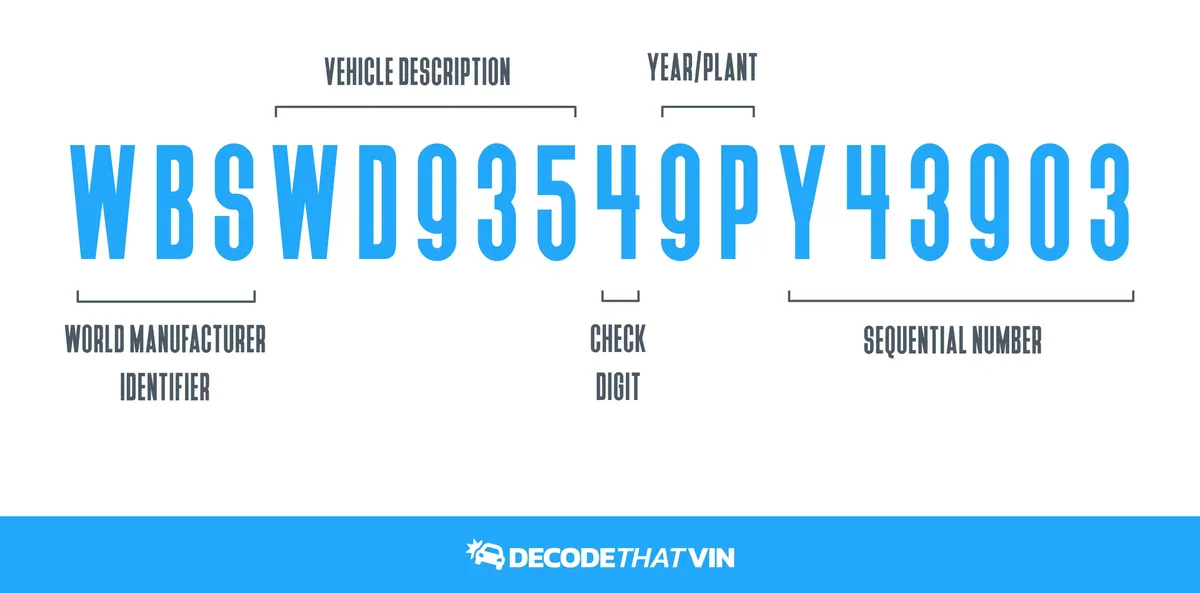
The VIN is not a random string: every position has a meaning. Since the 1981 model year, vehicles sold in the US have a 17-character VIN without the letters I, O and Q. Before that, each maker used its own format, often shorter, which a modern decoder cannot read.
What Is a VIN Decoder?
A VIN decoder is an online tool that helps car buyers and owners quickly understand the data coded into a car's VIN. Decoding takes four simple steps and is free:
- Enter your VIN into the VIN decoder search bar.
- Click “Decode”.
- Get free information about your vehicle in seconds.
- Read the result on your laptop or your phone.
As you can see, the process is straightforward.
A VIN decoder shows details such as the make, model, engine, transmission type, year and place of manufacture, and serial number. Comparing them with the car in front of you helps protect you from fraud, especially when you buy a used car.
Locating Paint Code in a VIN
Your VIN doesn’t explicitly indicate your car’s paint code, the code used to match paint to the car’s exact shade. On most cars the color codes are on a tag in the driver's door jamb, along with other details about the car. These tags often list two codes, one for the interior and one for the exterior, sometimes labeled "trim" and "paint."
Sometimes the paint code is harder to find. If it is not in the door jamb, check your owner's manual, which usually shows where the color code label is.
Is a VIN Decoder Safe?
Yes. Decoding a VIN does not reveal who owns the car: a decoder only reads the maker's codes. In the US, owner names and addresses in DMV records are protected by the Driver's Privacy Protection Act and are not given to the public by VIN.
Showing the VIN in a sale listing is normal and helps honest buyers check the car. The real risk is VIN cloning, where a thief copies the VIN of a legal car onto a stolen one of the same model. That is why a buyer should compare the VIN on the dashboard, the door jamb and the title, and check the history.
How to Decode a VIN Number
This section shows you how to read a car’s VIN, character by character, and what each part tells you about the car. Knowing it also makes it easier to find the right parts.
The first three characters of the VIN identify the manufacturer, the country of origin and the division within the company.
1st – A letter or number showing where in the world the car was built:
- A-H – Africa
- J-R – Asia
- S-Z – Europe
- 1-5 – North America
- 6-7 – Australia and New Zealand
- 8-9 – South America
2nd – The manufacturer
3rd – The manufacturer’s division or vehicle type
The next five characters (4–8) describe the car. Each maker uses them in its own way, but a common pattern is:
4th – Safety features and model-specific information
The fourth character gives model-specific details, such as the restraint system.
5th – The car’s series
The series of the model, usually shown as a letter.
6th and 7th – The body style
Convertible, sedan or hatchback: the 6th and 7th characters show the car’s body style and type.
8th – The engine
The eighth character usually identifies the engine, often with a letter. This helps when you buy parts, because it tells you exactly which engine the car has.
9th – The check digit, which confirms that the VIN is valid
It is calculated from the other 16 characters with a fixed formula. Doing the math by hand is tedious, but our check digit calculator or any good VIN decoder does it for you.
10th – The model year
It is a letter or a number; the table below shows which model year each code stands for.
| 10th Digit | Year | 10th Digit | Year |
|
A |
1980 |
Y |
2000 |
|
B |
1981 |
1 |
2001 |
|
C |
1982 |
2 |
2002 |
|
D |
1983 |
3 |
2003 |
|
E |
1984 |
4 |
2004 |
|
F |
1985 |
5 |
2005 |
|
G |
1986 |
6 |
2006 |
|
H |
1987 |
7 |
2007 |
|
J |
1988 |
8 |
2008 |
|
K |
1989 |
9 |
2009 |
|
L |
1990 |
A |
2010 |
|
M |
1991 |
B |
2011 |
|
N |
1992 |
C |
2012 |
|
P |
1993 |
D |
2013 |
|
R |
1994 |
E |
2014 |
|
S |
1995 |
F |
2015 |
|
T |
1996 |
G |
2016 |
|
V |
1997 |
H |
2017 |
|
W |
1998 |
J |
2018 |
|
X |
1999 |
K |
2019 |
11th – The plant where the car was built
The last six characters (12–17) are the vehicle’s serial number on the production line. You will rarely need them, but they can help you find the right part when a maker changed a model during production.
Knowing how to read your car's VIN helps you buy the right parts and keep the car in good condition. It is also a good way to learn more about a used car before you buy it.
Of course, there is an easier way to decode a VIN number than reading the characters one by one: an online VIN decoder does it in seconds.
Locating VIN on Car
The VIN is also stamped into the body or chassis, usually in the engine bay or under the plastic trim around the driver or passenger door opening. Because it is unique to each vehicle, the police can easily identify the car in their databases.
Locating VIN on Motorcycle
The VIN can be in several places on a motorcycle, so you may need to look around. On most motorcycles it is stamped into the right side of the steering head, the part of the frame the forks pass through, just below the handlebars.
Locating VIN on Trailer
On fifth wheels, travel trailers and other towable RVs, the VIN is on a metal plate or on the federal certification label, usually near the bottom of the left front sidewall (the roadside).
Why Is the BMW VIN Decoder Not Working?
BMW dealers and parts catalogs often identify a car by the last seven characters of the VIN (the "short VIN"). A short VIN is not enough for a decoder: enter all 17 characters. If a full VIN is still not recognized, the usual causes are a typo (O for 0, I for 1), a European-market VIN whose 9th and 10th characters are not a check digit and a year, or a vehicle built before 1981. Our check digit calculator shows whether the 17 characters are consistent.
Conclusion
You need your car's Vehicle Identification Number (VIN) to buy auto insurance or to get a vehicle history report, and many websites offer free VIN number searches. If you are thinking about buying a used car, get a vehicle history report first. It tells you about previous owners, accidents and repairs, and whether the car was ever reported stolen. You can also see whether the manufacturer issued a recall for the vehicle and whether the repair was done.